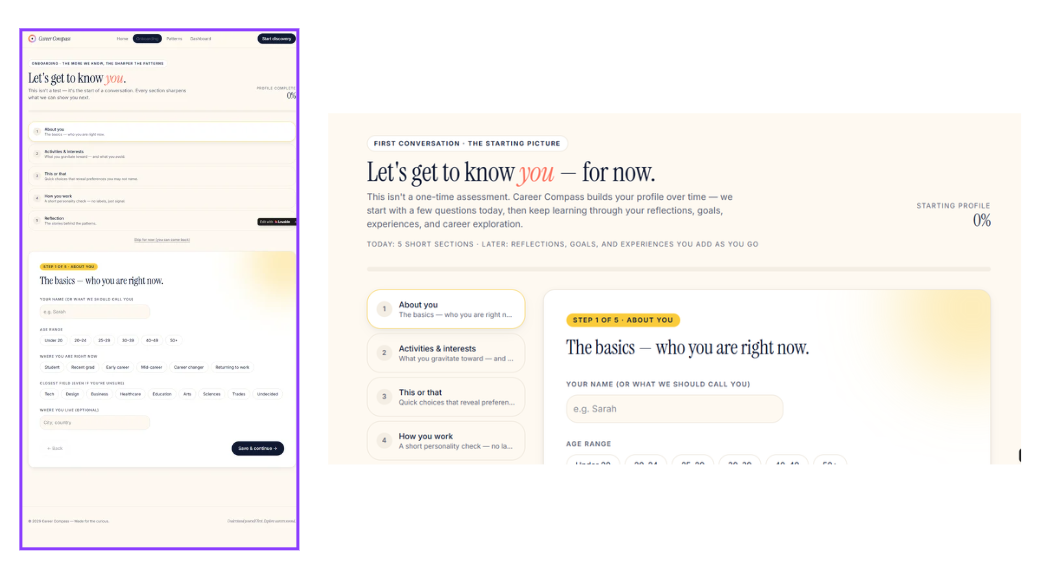
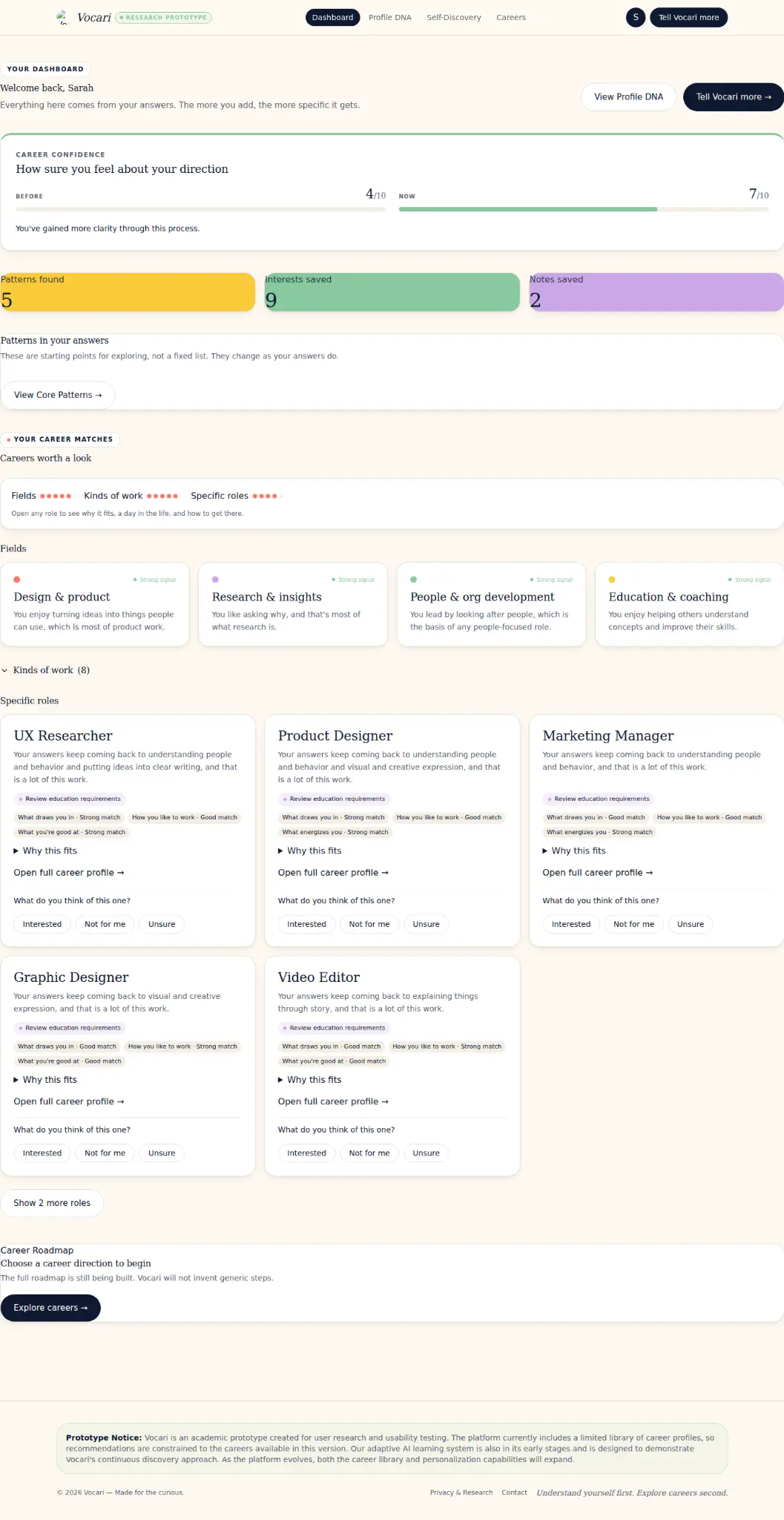
People wanted guidance connected to their actual experiences.
Generic results felt incomplete when participants could not see how their interests, strengths, skills, values, motivations, memories, and lived experience shaped a recommendation.
An independent AI/product innovation project focused on adaptive career discovery, behavioral signals, profile learning, user trust, feedback loops, and responsible AI interaction.
The project in 30 seconds
Career assessments often produce fixed labels and recommendations people cannot meaningfully evaluate.
I conceived, named, designed, and built Vocari, including its product system, research direction, information architecture, interface, and working prototype.
Use purposeful AI conversations to reveal strengths people may not recognize in themselves, then connect those abilities to career possibilities they may never have considered.
Product Creator, Product Designer & Prototype Developer
May–August 2026
Product strategy, interviews, surveys, usability testing, affective-computing research, IA, interaction design
Lovable, ChatGPT, GitHub, Vercel, React, TypeScript, Supabase, MorphCast, Figma
Academic research prototype with a limited career catalog and early-stage personalization. The link demonstrates current capability, not the full product vision.
The challenge
Design and build a trustworthy AI-enabled career-discovery platform that asks purposeful questions, recognizes patterns people may miss, improves recommendations through confirmed evidence and reflection, and remains honest about the limits of its current prototype.
People with nonlinear experience often struggle to translate what they have done into a clear future direction. Traditional career assessments can flatten that complexity into fixed labels and unexplained matches.

Generic results felt incomplete when participants could not see how their interests, strengths, skills, values, motivations, memories, and lived experience shaped a recommendation.
Users needed to inspect the evidence behind an interpretation, question it, and understand realistic tradeoffs before trusting the next step.
Self-report, observed hesitation, exploratory MorphCast data, and teammate-led heart-rate testing showed that ease of use and emotional support could diverge.

Eight participants completed the affective-computing study; usable facial analytics were available for three. The findings were exploratory and informed research questions, not consumer personalization or claims of emotional accuracy.
Designing the system behind the interface
Fixed assessment results
Unexplained recommendations
Invisible profile changes
Turn every AI interaction into a transparent, correctable learning loop.


I created the Vocari Product Book, Progressive Discovery Engine, product vision, and Career Content & Data Specification to keep experience language, profile evidence, recommendation logic, career facts, and future AI behavior aligned. These documents explicitly distinguish current capability, approved direction, and long-term vision.
The solution direction
Purpose-built prompts help AI notice recurring patterns across experiences, interests, values, motivations, skills, preferences, memories, and reflections without declaring a permanent personality type.
Understand, Clarify, and Challenge interactions let users inspect an AI interpretation, add context, preview a proposed change, and decide what becomes confirmed evidence for future recommendations.
People often overlook abilities that come naturally to them. Vocari connects recurring evidence of strengths, problem-solving patterns, motivations, and ways of working to careers they may never have considered, expanding options instead of narrowing them.
Vocari is designed to learn through purposeful questions and confirmed evidence, not passive surveillance. Over time, the same loop can support resource recommendations and reflections that deepen the profile again.
Vocari asks a focused question selected to fill a meaningful gap in what it understands.
AI looks for patterns across confirmed experiences, skills, values, motivations, interests, memories, preferences, and real-life context.
The user can understand, clarify, challenge, or reject the interpretation before it changes Profile DNA.
Recommendations show where recurring strengths and motivations are valuable, opening unfamiliar career possibilities without ruling out any path.
The user reflects on a career, activity, or future learning resource, creating new evidence for the next interaction.
Recommendations are invitations to explore, not judgments about what someone can or cannot do. The goal is to make overlooked strengths and unfamiliar possibilities visible.

During high-intensity prototyping, platform resource limits began interrupting iteration. Instead of pausing development, I established an alternate workflow: bringing relevant codebase context into ChatGPT to develop targeted patches, reviewing and pushing changes through GitHub, and using Vercel's automated deployments to keep the working prototype available for continued validation.
The workflow reduced dependency on a single prototyping platform while preserving version history, deployment continuity, and the ability to keep testing live product decisions.
Outcome, boundaries & reflection
The working prototype established the structured foundation: profile evidence, rule-derived patterns, explainable career recommendations, public exploration, authenticated persistence, and consent-aware research instrumentation. The approved AI direction adds purposeful conversations that transform user-confirmed context into progressively better recommendations.
Longitudinal AI conversations, broader career coverage, recommendation calibration, accessibility, and resource recommendations that improve through reflection.
MorphCast remained isolated research instrumentation and did not influence consumer recommendations.
The hardest product challenge was not simply adding AI. It was designing a learning loop that could recognize patterns, improve through interaction, and still keep its evidence visible, correctable, and user-controlled.
Information architecture and search strategy redesign for a global open-source software marketplace.